




What Is PEI Plastic?
Before learning how to identify it, it is important to understand what is PEI plastic.
PEI plastic, also known as Polyetherimide Plastic Material, is a high-performance engineering thermoplastic widely recognized for its excellent thermal resistance, mechanical strength, and inherent flame retardancy. One of the most well-known commercial forms of PEI plastic is ULTEM PEI plastic, which is commonly used in demanding industrial, electrical, medical, and aerospace applications.
Because PEI plastic material is often confused with other high-temperature plastics such as PC, PPS, or PEEK, proper identification is essential—especially when selecting materials for CNC machining, injection molding, or high-heat environments.
This article explains how to identify PEI plastic using visual inspection, physical properties, burning behavior, machining characteristics, and professional testing methods.
Understanding PEI Plastic Material
What Is PEI Plastic Made Of?
PEI Resin is an amorphous thermoplastic polymer composed of aromatic rings and imide linkages. This molecular structure gives PEI material its outstanding heat resistance, rigidity, and dimensional stability.
Key characteristics of PEI plastics include:
Continuous service temperature up to 170–180°C
Glass transition temperature around 217°C
Inherent flame retardancy (UL94 V-0, without additives)
High strength and stiffness
Excellent electrical insulation
Good chemical resistance
Because of these properties, PEI plastic material is often supplied in the form of PEI plastic sheet, rods, tubes, and precision-molded components.
Visual Identification of PEI Plastic
Color and Transparency
One of the easiest ways to identify PEI plastic is by its appearance:
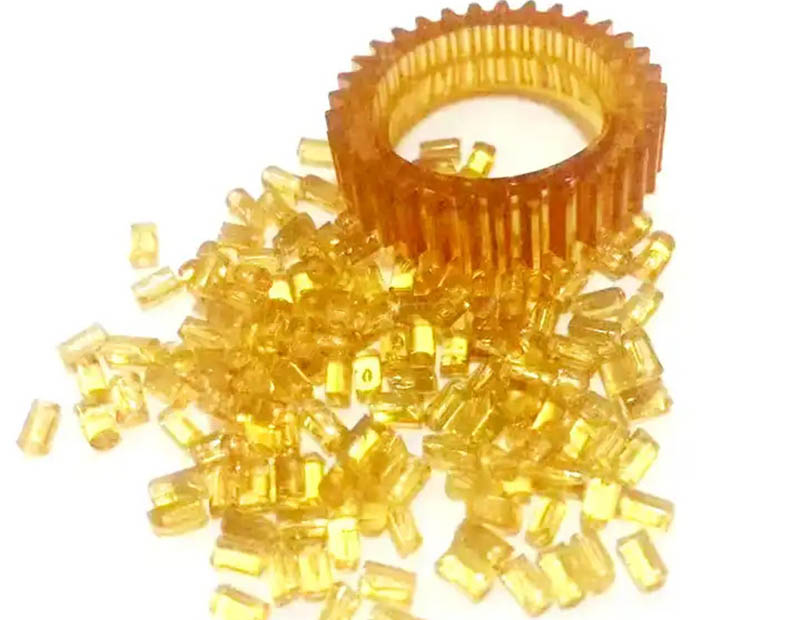
Typically amber, translucent brown, or yellowish
Semi-transparent rather than fully clear
Some grades may appear black when combined with High Temperature Black Masterbatch, but still retain PEI’s inherent rigidity
Tip: If you see a hard, amber-colored engineering plastic sheet, there is a strong chance it is a PEI plastic sheet.
Physical Property Identification
Hardness and Rigidity
PEI material is noticeably rigid and stiff:
Difficult to bend by hand
Resistant to surface scratching
Feels harder than ABS or nylon
Heat Resistance Test
When gently heated (for example, with controlled hot air):
PEI plastic resists softening
Maintains shape far longer than PC or ABS
Does not melt easily under moderate heat
This excellent thermal behavior is a defining feature of Polyetherimide Plastic Material.
Burning Characteristics (Controlled Environment)
Burn testing should only be conducted by trained professionals.
When tested, PEI plastics show distinctive behavior:
Difficult to ignite
Self-extinguishing when flame is removed
Produces minimal smoke
Leaves a dark, rigid residue
These flame-retardant properties come directly from the molecular structure of PEI resin, not from added flame retardants.
Machining Characteristics of PEI Plastic
For engineers familiar with CNC operations, machining behavior can help identify PEI plastic material.
During CNC milling or turning:
Chips are short and brittle
No melting or stringing
Excellent dimensional stability
Clean surface finish after machining
Because of these traits, ULTEM PEI plastic is frequently chosen for high-precision CNC components, fixtures, and electrical insulation parts.
Professional Identification Methods
For absolute confirmation, laboratory testing is recommended.
FTIR Analysis
Identifies chemical structure
Confirms PEI resin composition
DSC (Differential Scanning Calorimetry)
Detects glass transition temperature (~217°C)
Distinguishes PEI material from PC or PPS
Material Documentation
Look for datasheets or certificates listing:
Polyetherimide
PEI plastic
ULTEM PEI plastic
PEl Plastic Material / PEl Resin
Differentiating PEI from Similar Plastics
| Material | Appearance | Heat Resistance | Flame Retardancy |
|---|---|---|---|
| PEI plastic | Amber, translucent | Excellent | Inherent |
| PC | Clear | Moderate | Limited |
| PPS | Dark, opaque | High | Good |
| PEEK | Opaque | Very high | Very good |
Understanding these differences helps avoid costly material selection errors.
Common Applications of PEI Plastics
Due to its superior performance, PEI plastic material is widely used in:
Electrical and electronic insulation components
Aerospace interior parts
Medical device housings
Semiconductor equipment
Automotive high-temperature fixtures
CNC-machined structural parts
In many of these applications, PEI plastic sheet and rods are preferred due to their machinability and stability.
How to Identify PEI Plastic
To correctly identify PEI plastics, focus on the following key indicators:
Amber or translucent brown appearance
High rigidity and surface hardness
Exceptional heat resistance
Self-extinguishing flame behavior
Stable CNC machining performance
Laboratory confirmation via FTIR or DSC
By understanding what is PEI plastic and recognizing its defining features, engineers and manufacturers can confidently select Polyetherimide Plastic Material for high-performance and high-temperature applications.
